
Topics | Literature | Fantasy | Tasks & exercises
Tasks & exercises
Working method: Individual work, pair-work or group work
Product: An illustration of the Fantasy genre
Anne Mette Finderup and Agnete Fog presents a number of fantasy characteristics in their anthology Worlds of Fantasy (2005). Read the text and create an illustration of the Fantasy genre and its characteristics regarding setting, characters, plot, structure etc.
Working method: Individual work, pair-work or group work
Product: An illustration of the Fantasy genre
In the following text, Anne Besson examines the origin of the Fantasy genre and establishes the genre. as a product of Victorian England, but what is Victorian England?
1. Research Victorian England and be prepared to present your findings in class.
2. Read the text and answer the questions.
 Questions
2. What is realism, and why was fantasy seen as the opposite of realism?
3. How did interest in the medieval past influence writers and artists? Do you recognize that in Harry Potter?
4. Which writers from Victorian England are named as pioneers of fantasy, and what did they write?
5. How did the Gothic movement add to the growth of fantasy?
6. How did the British Empire inspire fantasy stories?
7. The article says fantasy was sometimes a “resistance to modernity.” What does this mean?
8. How are the generes folklore and fairy tales similar to Fantasy?
9. How was Victorian fantasy different when written for children compared to adults?
10. How did the culture and literature of late Victorian and early twentieth-century England prepare the way for modern fantasy?
Working method: Individual work, pair-work or group-work
Product: Song analysis
The video in the following exercise is Jefferson Airplane's White Rabbit from 1967. The song includes obvious allusions to Alice's Adventures in Wonderland . Analyse the song using focusing on form & structure, poetic language and themes.
Working method: Individual work, pair-work or group work
Product: Textual analysis
The text in this exercise is chapter one of Lewis Carroll 's infamous Alice's Adventures in Wonderland (1865), in which Alice enters the parallel world of Wonderland through the rabbit hole.
1. Read the text and pay attention to fantasy characteristics.
2. Analyse the text focusing on the character of Alice as well as the setting.
Working method: Individual work, pair-work or group work
Product: Points for a class discussion
The text in this exercise is an article entitled "Is Alice in Wonderland really about drugs?" published on the BBC website on the 20th of August 2012.
1. Read the text and briefly consider the rhetorical pentagram.
2. Can you think of any other works of fiction that includes drug references or is widely believed to be about drugs?
Working method: Individual work, pair work, or group work
Product: Song analysis
The video in the following exercise is "Somewhere Over the Rainbow" from 1939. The song was included in the film adaptation of The Wizard of Oz (1939) by Victor Fleming , in which the main character Dorothy dreams of a magical land far, far away. Analyse the song, focusing on form & structure, poetic language, and themes.
Working method: Group work
Product: Presentation
Aims of the exercise: Knowledge of methods
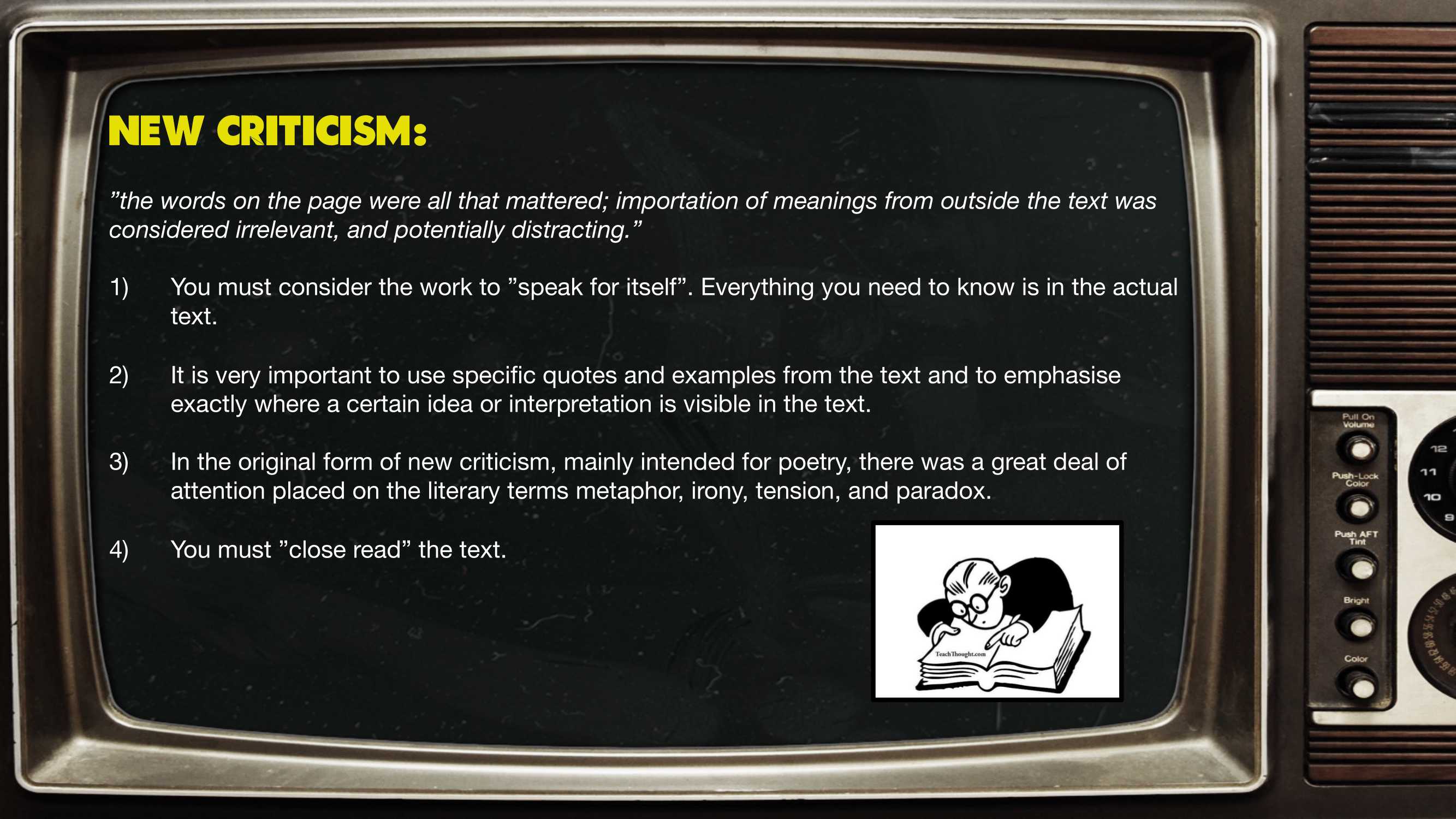
This exercise aims to analyse the film The Chronicles of Narnia: The Lion, the Witch and the Wardrobe from 2005 directed by Andrew Adamson using the four most common analytical approaches in English. Click here to open slides on the four different analytical approaches.